Tuesday, March 01, 2011

Jack & Rod's Portraits

Here are a couple of portraits I did recently of a super-nice couple from San Francisco. They had emailed me some photos of their city-hall marriage ceremony, where I thought they looked like identical twins, but when I actually sat to paint their likenesses I discovered how very different they really are.

My technique is pretty idiosyncratic, and far from the ideal of the traditional atelier with its careful rendering and painstaking glazing. I block things in quickly and very casually, with the knowledge that I can always remove the paint if I make an error, which I usually do. My progressive bifocals can play havoc on my vertical and horizontal proportions, and I sometimes have to overlap an actual photo on my computer with a jpg of the painting to catch the problem areas. But over the years I have developed a pretty good feeling for putting things in place and anticipating what colors I will need. My favorite is the bluish tinge of a 5 o'clock shadow, much to the consternation of Rod, who was careful to shave for the following sitting!

My portrait heroine is the painter Alice Neel. I also adore and admire Don Bachardy who is an amazing artist.


Wednesday, February 16, 2011

Painting with John Matsushita

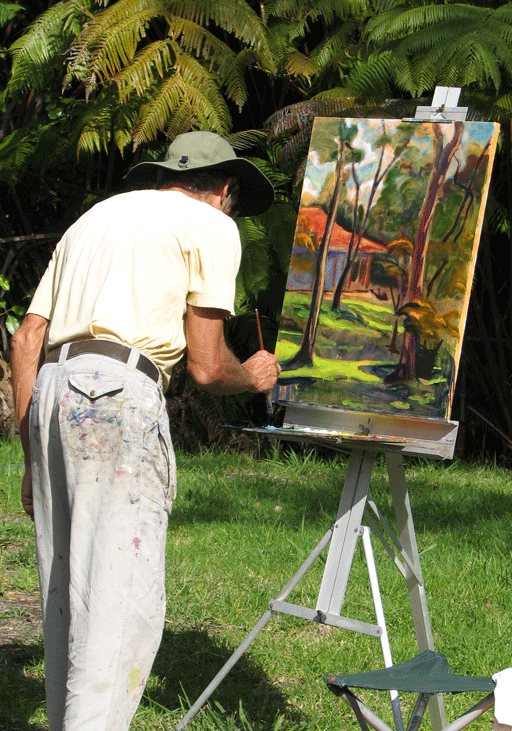
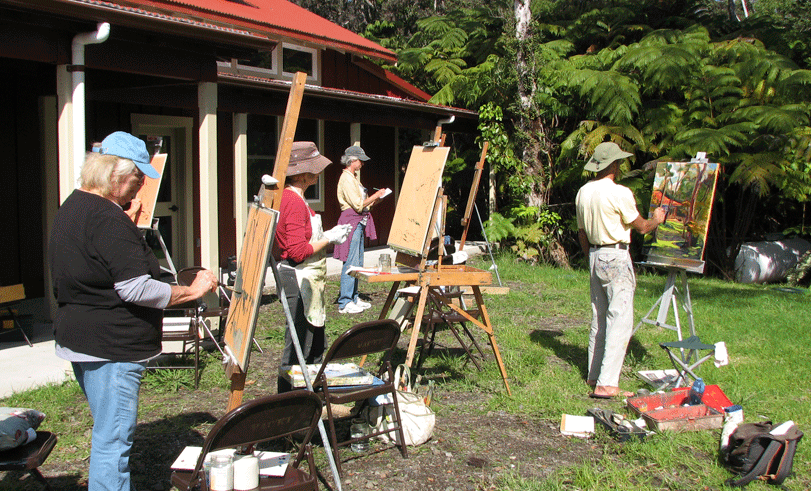
Two weekends ago Rod Cameron invited Tuko, and by extension, Cosette and myself, to go up to the rainforest near Mountain View and paint in a treehouse. Not wanting to miss anything involving the famous Rod, I joined the group for an exquisite day of plein air painting among the giant hapu'u ferns, ohi'a and olapa trees, and clambering anthuriums. The treehouse is the creation of an ingenious builder named Sky, and to his credit it actually did not kill the beautiful big ohi'a trees that it surrounded. Truly a magical experience. Also present were the beautiful Anne Catlin and her good friend John Matsushita, who is giving an encaustic workshop soon. These are the details:


Encaustic Wax Painting Workshop

Beginning this February, local artist and adventure seeker John Matsushita will be teaching a workshop on the tradition of encaustic wax painting. Class space is open to 12 students at any age and skill level for intimate and personal learning. Painting classes begin Saturday, Feb 19th from 9am-1pm and run 5 consecutive Saturdays (Feb.19, 26, March 5, 12, 19) with an option of extension.

Sensitive to touch and temperature extremes, the tradition of wax painting has been in practice for thousands of years. Despite their seeming fragility, encaustics preserve very well, with examples in Egyptian and Greek artifacts dating back to 800 B.C. The Greeks applied wax and resin for weatherproofing, eventually using it for decoration upon warships. Perhaps the best known encaustic works are the funerary portraits painted throughout Egypt over 1,500 years ago.

Students are invited to bring unconventional materials to experiment with the wax. They will learn basic and advanced applications and can create at their own pace. Additional assistance will be provided for those in need. $300 includes materials, with financial aid and member discounts available.

John Matsushita is Hawaii-born and raised, with a BA in Fine Arts from the University of Hawai'i –Manoa, with study at the Art Institute of Southern California, Laguna. As a painter he works in molten wax against recycled wooden panels that he salvages from construction refuse. His encaustic paintings have been featured at VAC’s Emerging Artist Exhibit and he is currently represented in the Volcano Art Gallery. As a sculptor, he works in wood and stone, which he carves away to reveal landscapes and features of the natural environment that he feels a sense of deep connection with. His artistic focus has largely involved volunteer projects with limited resources beyond natural materials that have been foraged from the land itself.
This class will take place at the Volcano Art Center’s Niaulani Campus: 19-4074 Old Volcano Road. For more info, call 967-8222 or visit www.volcanoartcenter.org.

Monday, February 07, 2011

Plein Air Class at Volcano Village

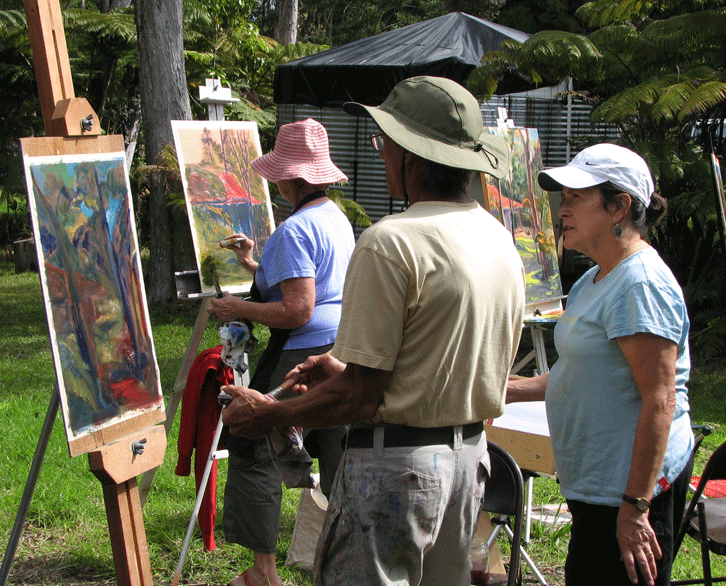
These photos were take by Everett Charters on Sunday, January 30, 2011 .

Hats off to the students who attended my plein-air oil painting class up in Volcano Village last Sunday. It's not an easy thing to tackle a new way of applying and manipulating paint, and some of you had never even used oils before! I'm hoping that some of the fear factor may have been dissipated and that you might be encouraged to try the technique on your own. Remember that representation of a scene is really optional, and that oil paints can be used to play around and do just about anything that you can conceive of!

Just acquire a few colors (people get rid of paints at garage sales frequently) and use any old surface, and have some fun!

I'll be happy to help with any questions, and would love to receive your feedback on the class. Write to me at arthurjohnsen@hotmail.com

Aloha!
Arthur


Thursday, January 27, 2011

Plein Air "Takeaway" Technique

I’ll be teaching this oil-painting technique on Sunday, January 30 at the Volcano Art Center's Niaulani building in Volcano Village. Here are some notes to ponder:

Paints to use when starting a painting (more transparent, dry quickly)


For Trees, buildings, etc:

Ultramarine Blue
Prussian Blue (good for the ocean)
Dioxazine Purple
Yellow Ochre
Viridian Green
Sap Green
Alizarine Crimson
Burnt Sienna
Burnt Umber
Indian Yellow (very strong clear transparent yellow)
Permanent Rose
Quinacridone Magenta

For sky areas and for a sense of distance (use sparingly):


Naples Yellow
White
Cobalt Turquoise (good for ocean and underwater seafoam)

Paints to use only later in the process (very opaque, dry very slowly):


Cadmium Yellow Light (or Cad. Lemon or Hansa Yellow)
Cad. Yellow Medium or Dark
Cadmium Orange
Cadmium Red Light, Medium, and/or Dark
Cad Light Green
Permanent Green
any Gamblin Radiant Series

Regard the scene (or still life or figure). See if you can “grok” the overall dance or movement of what’s going on. Is there a focal point of interest? Is there a path going into the space? (consider inventing one if there is not!) Does the space between things do any special movement? (i.e. a tunnel of space over a shady lane, or a sweep of air along a coastline, or mysterious glades among treetrunks...) What emotion is expressed by this scene? Squint if it helps to see the larger masses and the overall pattern. If the light is doing something truly amazing, take a picture now since those effects rarely last! Same thing with animals or people doing interesting things in your scene.

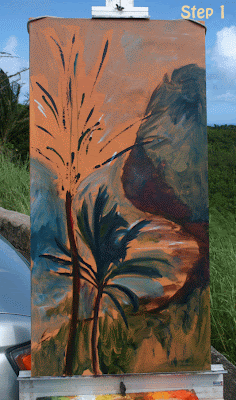
Step 1: Dot paint directly from tubes onto canvas for quickest results. Your choice of color now will set the tone for the whole painting. Balance observation with fantasy and imagination regarding color! Use your largest brush to mush paint into approximate shapes without regard to lighting effect, just simplified silhouettes. Let the tones be in the middle, neither very light nor very dark. Cover the canvas completely with thinned paints, using either turpentine or turps mixed with some dryer. Borrow paint with your brush from heavier areas if needed to distribute and re-arrange. Note that more distant objects are lighter in tone, so add white or let the paint be more transparent.

When the whole canvas is covered, take a moment to congratulate yourself. Eat a cookie and drink a sip of your hot tea.

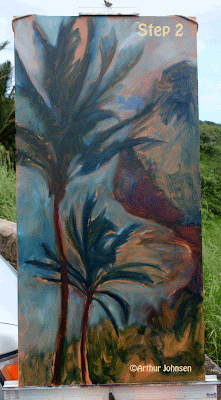
Step 2: Use a medium size brush dipped in darker paints to draw shadows and structural details. Adjust the darkness so more distant objects are sketched in lighter tones. This would be the time to add the more important tree trunks and branches.

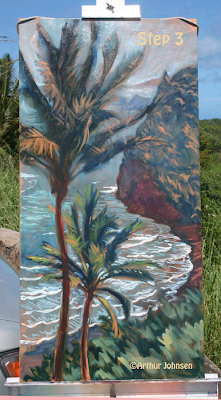
Step 3: Then take a rag in one hand and dip a smaller clean brush in thinner. A t-shirt rag on your finger works well for this step, or just keep re-cleaning the brush. Start wiping away areas where the sun directly hits the objects: rooftops, tree bulges facing the sky, sunlight patches on a road surface or a lawn, linear streaks along tree trunks facing the light.
If the canvas has been toned a deep color, this step may take some imagination and delayed gratification since you are working to achieve a sense of light.

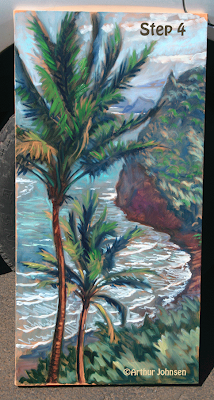
Step 4: Start adding highlights using strong, thick opaque paints. Now’s the time for cadmiums. Sunlight is yellow, and so a stronger effect of light can be achieved with yellow tints. White clouds can have a pure yellow edge to pop them against the blue sky. Tree trunk highlights can have a cadmium orange edge to pop them against all the green and blue shadows. Road highlights can be pink, yellow or orange depending on the paving material. Lawns and trees can have pure yellow or cadmium green light highlights. Permanent Green can be used sparingly. The Gamblin Radiant Series can be helpful.

Time and energy permitting, the final working of the painting can go on to whatever level of exactitude you prefer. Take photos of the scene if you like so you can tweak the details later. But oftentimes the first bold approach will result in a fresh, exciting painting that might not be improved with a lot of fussing!

Thanks as always to Roger Montoya of New Mexico for always generously sharing his techniques!


Wednesday, January 26, 2011

Afternoon at the Gallery, January26

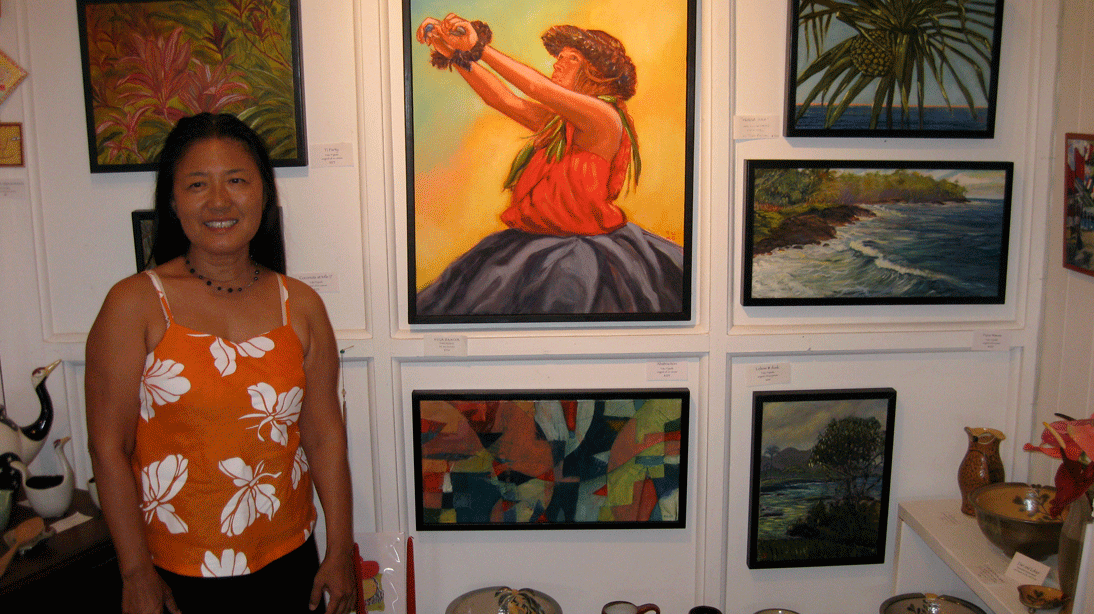
These are some photos from around the gallery just to show what's new this year. I'm always on everyone's case to keep producing new art, but the truth is that it's pretty challenging to keep it coming! New, fresh art is often the first to get sold, and so sometimes it can seem like the gallery doesn't change very much. But it does have its progression of novelty....

We looked longingly at a space that's opening up on bayfront, just down from Sig Zane's very prestigious store. Dreams of expansion and better exposure danced in our heads, but the rent (double our current, plus lots of insurance needs!) was daunting. A mishap with a very grouchy manager clinched the non-deal, as he threw Cosette and Tuko out of the space for just being there looking around! We think we'll stick with our current location and our friendly landlords!

To celebrate Valentine's Day and month, we are having a sale on cards, t-shirts, pareos and boxes. I personally love the little hand-crafted items, but they take a lot of time for the $$ amount we can charge. But it's just this sort of thing that will be popping up on those TV antiques road shows in future years, unbelievably rare items from the hands of artists!

I'll be teaching an oil-painting workshop this Sunday up in Volcano Village, at the Niaulani campus of the Art Center. It's been a while since I've taught, so it will be a good chance to brush up on my people skills and communication arts.

A friend of David Hubbard provided this shot of him working on a portrait.


Sunday, September 05, 2010

Fifth Anniversary Celebration!

Everett took these photos of us in front of our works, and some shots of the party we had on Friday September 3. Noticeably absent are the dynamic duo of Leslie Sears and David Hubbard, but we'll post their photos eventually. Everett is updating our website arthurjohnsengallery.com and has been compiling files of photos to draw upon.

The main news this month is that Sonya has to leave the islands due to her husband's allergies. This is a bummer because she is a super nice person and her artworks are very beautiful. In an effort to lighten her load and send her happily on her way, we are holding a silent auction of her paintings and pastels. This is an extraordinary opportunity to purchase gorgeous artworks at a very minimal price! Many of the pastels are unusually framed with custom matboards with real sand texturing them. The auction will last until the end of September.

The opening was fun and well attended. We always have tasty and abundant food to share, which I imagine has an attractive effect. Up the street at the East Hawai'i Cultural Center, a group of environmentally active artists opened a show of native species and habitats, while in a side gallery John Mydock presented an array of very spectacular turned and carved and radically painted wooden objects. In my humble opinion this show establishes his position as one of the Big Island's most powerful and creative artists, much as Henry Bianchini's amazing show did in July at the same venue.